
Which 3235 Rolex Replica Is Actually Worth Your Money in This Australia Drop
The Australia Drop Changes Stock, Not Quality
Every few months the same rhythm repeats. A batch goes live at a time that suits Australian buyers, a countdown runs, and the popular references are gone inside a day. I have watched three of these cycles play out now, and the thing nobody says clearly enough is that a drop changes availability, not build quality. The workshop that assembled a Submariner on Monday assembled the one you buy on Friday, with the same parts, the same tolerances and the same batch of movements.
What is really happening is inventory release. Sellers hold stock back until a new batch is confirmed, then clear the shelf to make room. Australian buyers see it first purely because of the timezone offset: a listing that goes live at 9pm in Sydney is late morning in Europe and pre-dawn in the US, so the first six to eight hours are effectively this region’s window. The references that vanish first are the ones with the most macro photography circulating online, which is why the Submariner 126610LN, the fluted Datejust 41 and anything GMT disappear before lunch.
Why that matters is simple. On a normal day you take whatever is in stock. On drop day you can compare two or three individual units of the same reference, and that comparison is worth more than any spec sheet. QC photos arrive with the protective film still on, shot in flat light, which is fine for checking alignment and date centering and useless for judging bracelet brushing and dial sheen, the two things you actually notice after a week on the wrist.
My rule is to ask for one extra frame before paying: film off, case tilted about forty-five degrees, raking light across the dial. That single photo tells you more about a rolex replica dial than nine straight-on shots, and in my experience the sellers who refuse that request are the ones shipping whatever the batch hands them. It costs nothing to ask and it filters a lot of noise.
So the practical takeaway is this. If you have already settled on the movement, buy early on drop day and accept that the unit is not hand-picked. If you have not settled on the movement yet, the drop is a distraction dressed up as urgency. Most of the regret I see comes from buyers who committed on a timer and then discovered the same reference exists with a better caliber for a hundred and fifty dollars more, which is a bad trade on a watch you plan to keep.
The Movement Is Where the Money Goes: 3235 Clone, 3135 Clone, Generic 2824
The case and dial are what you look at. The movement is what decides whether the watch is still on your wrist in year three or sitting in a drawer with stripped keyless works. This is where the gap between a four-hundred-dollar watch and an eight-hundred-dollar watch actually lives, and it is the part of the market most reviews skip, because you cannot photograph it with the caseback closed.
The first tier is the 3235 clone, and there are two versions worth knowing. The VR3235 and the DD3235 from Dandong. An older SH3235 still turns up in cheaper listings and should be treated as a genuinely different product, not a variant. All three are 1:1 clones of the Rolex caliber 3235 in the dimensional sense: 28.8mm diameter, the same bridge layout, the same keyless works, the same stem height and crown position, the date window sitting where the original puts it, and a 28,800 vph beat rate. Power reserve measures around 66 to 70 hours on a healthy VR3235, similar on the DD3235, and closer to 55 to 60 on the older SH3235.
The second tier is the 3135 clone, sold as SH3135 or VR3135. It is a 1:1 copy of the previous generation Rolex caliber, 48 hours of reserve, 28,800 vph, and it has been in circulation long enough that parts are cheap and nearly every watchmaker has handled one. The third tier is the generic A2824, 2836 or 2813. These are not clones of anything Rolex ever made. They are 38 to 40 hour movements that are reliable and cheap to replace outright, but the crown position, the date change feel and the winding action are visibly different, and on some cases the movement ring is shimmed to make it fit at all.
What “1:1 Clone” Actually Means Once You Open the Caseback
The phrase gets thrown around carelessly, so here is the honest version. A 1:1 clone means the parts are interchangeable in geometry, not in metallurgy. The clone date wheel sits where the genuine one sits, the rotor spins on the same bearing type, the bridges carry screws in the same positions, and a watchmaker opening the caseback sees the layout he expects. What it does not mean is that tolerances, surface finishing or materials match. The genuine 3235 uses a Chronergy escapement with nickel-phosphorus components; the clones approximate the geometry with conventional materials and looser tolerances. So when a seller calls the movement a true 1:1, they are telling you it is dimensionally correct. They are not telling you it will run like a nine-thousand-dollar caliber, and any listing that implies otherwise is worth walking away from.
Power Reserve in Real Use, Not on the Spec Sheet
The seventy-hour figure is real but conditional, and the condition matters more than the number. In my experience a VR3235 worn daily for two weeks will hold around sixty-five hours off the wrist, which is enough to survive a weekend in a drawer without stopping. The DD3235 behaves similarly. The catch is that the final ten hours of that reserve is where amplitude drops and timekeeping drifts, so if you rotate several watches you will still be resetting the time more often than the number suggests. The 48-hour 3135 clone is honestly easier to live with in a rotation, because you stop expecting it to survive two days and you stop being annoyed when it does not. On stability, a good 3235 clone sample runs within plus or minus eight to twelve seconds a day out of the box, and a regulation gets it to around five. The weak points are the reversing wheels on the automatic winding and the setting lever, both of which can wear, and the date change gets sticky if you habitually set the date between nine at night and three in the morning. Repair difficulty is the part nobody warns you about: many independent watchmakers in Australia will not service clone movements at all, and the ones who will often charge a flat hundred and fifty to two hundred and fifty dollars because they cannot source genuine parts. Budget for a movement swap in years three to five rather than a proper service.
Two Mistakes That Cost Buyers Real Money
Most buyers research in the wrong order. They start with the dial, then the bracelet, then the bezel insert, and only ask about the movement after the money has moved. The second mistake is subtler: people use cosmetic signals like dial text and rehaut engraving as a proxy for overall quality, when those are the cheapest things for a factory to get right and the least likely to fail on you. Both come from reading photo-heavy reviews instead of thinking about how the watch will actually be used, and both lead to the same outcome, which is paying for the wrong thing.
Mistake One: Paying Premium for a Case and Ignoring What Is Inside
I have watched this play out a dozen times. Someone pays top dollar for a well-known factory’s Submariner, gets a lovely case with correct lug shape and clean rehaut engraving, then discovers the listing was filled with an A2824 rather than the 3235 clone they assumed was standard. The seller was not lying. The listing simply did not specify, and the buyer never asked, because the photos were good and the price felt like a signal on its own.
The reason this happens is structural. Factories routinely offer the same reference with two or three movement options at different price points, and retailers list them under near-identical titles with the same hero image. The practical impact is a hundred and fifty to two hundred and fifty dollars difference in what arrives, plus a much bigger difference in resale and serviceability down the line. Before you pay, ask one direct question: which movement is inside this exact unit, and can you photograph the caseback before it ships. A seller who cannot answer that is not selling you a specific watch, they are selling you a category, and you will get whichever unit is closest to the door. A fake rolex with a well-finished case and a generic movement is a four-hundred-dollar watch whatever the listing says.
Mistake Two: Treating Dial Text and Rehaut Engraving as a Quality Shortcut
Dial printing is the cheapest detail to execute correctly and the easiest thing for a photo review to over-weight. I have handled units with crisp “Swiss Made” lettering and a clean laser-etched coronet at six o’clock that had bracelet end links sitting proud of the lugs and a crown that felt gritty after two weeks of winding. The parts that get photographed under a loupe are almost never the parts that fail.
The reason this matters is that the details buyers obsess over online are the ones that require magnification to see, while the ones that determine daily satisfaction are the ones you feel. The impact is a market where genuinely good watches get rejected over a two-tenths-of-a-millimeter gap and poor ones get accepted because the printing is sharp. After enough of these, my approach is to treat dial printing as a pass-or-fail gate and then move my attention entirely to bracelet fit, crown action, bezel alignment and the movement. If the printing is sharp, that box is ticked. Do not spend your budget there, because nobody at arm’s length has ever seen it.
Factory Comparison: Clean, VSF, ARF and Where Each One Actually Wins
No factory wins everything, and anyone who says otherwise is repeating a consensus from two years ago. Here is how the four names that matter compare on the references people ask about most, based on what I have handled and what I have seen come back for adjustment.
VSF is the strongest on the Submariner 126610. The case profile, the crystal and the cyclops magnification are the closest to correct, and their 3235 clone is the best-finished version of that movement in circulation. The weak points are bezel action, which is slightly stiff on some units, and insert numerals that occasionally read too white in daylight. Clean wins on dial printing and bezel insert colour. Their Datejust 41 dials, particularly the fluted and motif variants, are the best available, and their Submariner insert tone is closer to genuine ceramic than VSF’s. Their bracelets and clasps sit a small step below ARF in finishing, and their movement supply has shifted between VR3235 and DD3235 depending on batch, so ask rather than assume.
ARF still owns bracelet and case polishing. Datejust 41 and Day-Date end links sit the way they should and the clasp action feels right. The catch is movement: ARF has historically shipped with A2824 or SH3135 rather than a 3235 clone, which completely changes the value calculation. A beautiful ARF case with a generic movement is a four-hundred-dollar watch, not a seven-hundred-dollar one. BP and GMF occupy the budget tier, with decent dials and cases that are sometimes half a millimetre thick on the Day-Date, and the price reflects it. If the saving is two hundred dollars or more, that is a fair trade. If it is eighty dollars, it is not.
If you want to compare references side by side before committing, this rolex clone index is where I usually start, because it groups by reference rather than by hype, and you can see which factories actually produce which model before you get attached to a dial colour. The same logic applies across replica rolex watches in general: the factory name matters less than the specific reference, because most of these workshops are excellent at one or two models and average at everything else. The fake watches tier underneath this is where the real landmines sit, mostly sellers who list identical photos under four different shop names, because you cannot resolve a QC problem with a business that rebrands every quarter.
Wrist Test vs Macro Test: Where Your Money Should Actually Go
This is the part of the hobby that took me longest to internalise, and it changed how I buy.
Almost all online reviews are macro tests. Ten-times zoom photos, end link gaps measured to a fraction of a millimetre, rehaut engraving compared pixel by pixel, date font weight examined under a loupe. Those reviews are useful for identifying which factory produced which watch, but they are a terrible guide to whether you will enjoy wearing it. The problem is that they measure the watch in conditions that never occur in real life, and then buyers carry that standard into a purchase where it has no bearing on anything.
The wrist test is what happens in the real world. Someone sees your watch from fifty to seventy centimetres away, indoors, in motion, under mixed light. At that distance a hairline gap between bracelet and lugs is invisible. A tenth-of-a-millimetre difference in case thickness is invisible. Movement finishing is permanently invisible because the caseback is solid. What survives the wrist test is a completely different list: dial sheen and sunburst quality, bezel insert colour, cyclops clarity and whether the date is magnified enough, bracelet brushing direction, and the overall proportions of the case on your arm.
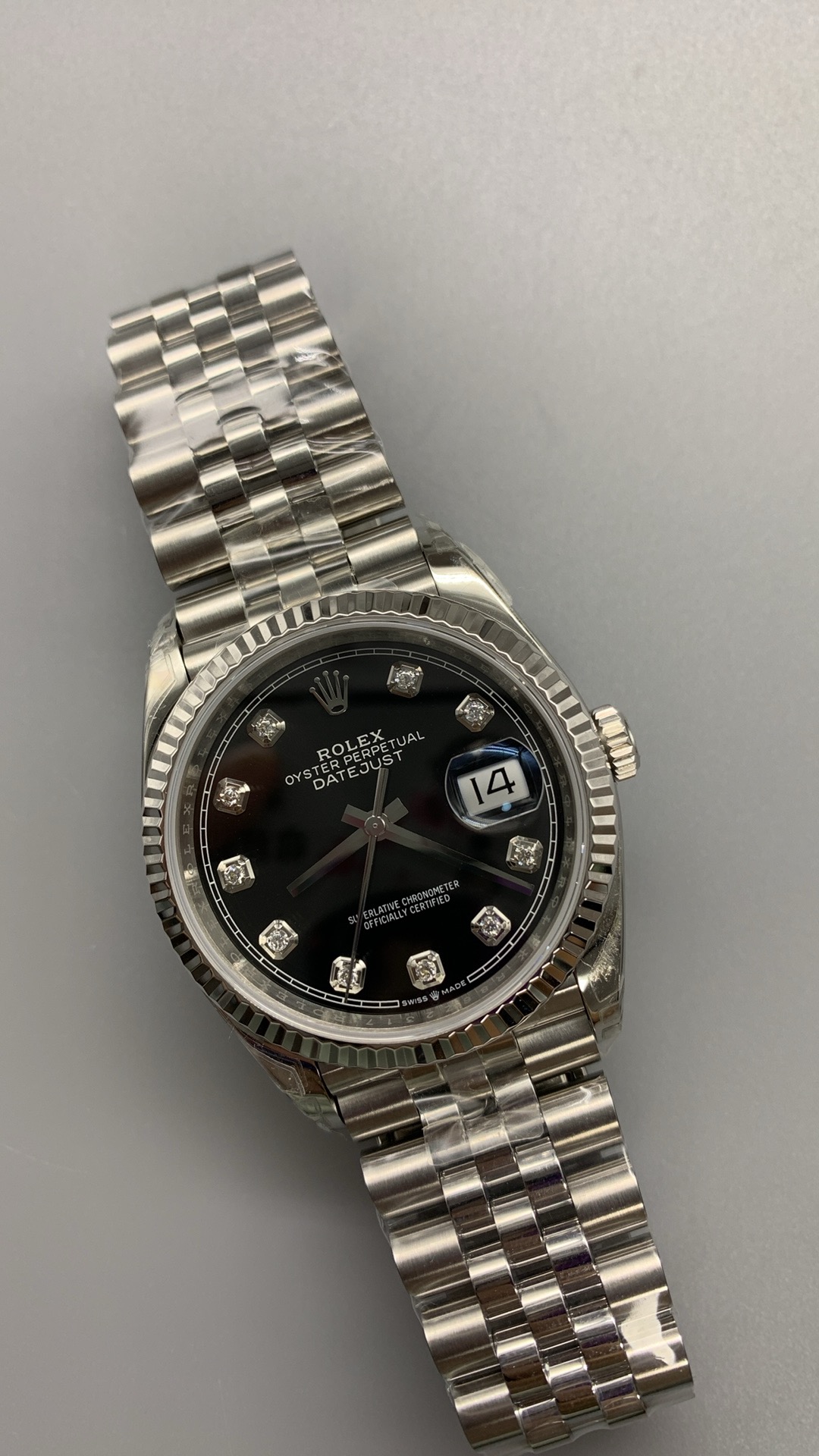
The rule that follows is to allocate budget by which test the flaw shows up in. Dial, insert, crystal and bracelet are wrist-test items and they deserve the premium. End link fitment, rehaut depth, caseback engraving and crown logo detail are macro-test items and should only drive your decision if you plan to sell the watch or post close-ups online. I have passed on units over a minor SEL gap and later regretted it, because after a week the gap was the last thing on my mind and the dial was the first. The exception worth naming is date font and cyclops magnification, which are wrist-visible in a way most people underestimate, because the date is the one thing you look at directly every single day. A rolex replica with a sharp dial and an under-magnified date will bother you more than one with a slightly dull insert. If you check only one macro detail before buying, check the date.
The same reasoning applies to replica rolexes more broadly. Buyers who obsess over the parts nobody sees end up paying macro prices for wrist-level satisfaction, and the ones who focus on the four wrist-visible items tend to be happier with cheaper watches and less likely to flip them three weeks later.
Price Bands, and the One Seller I Keep Going Back To
The market splits into three bands and they have been stable for a while.
Under five hundred dollars you are in A2824 or 2813 territory. These are fine as a second or third watch, they keep reasonable time, and when the movement dies you replace it for eighty dollars. What you give up is date change feel, crown position accuracy and any claim to a clone caliber. Between five hundred and six hundred and fifty you get 3135 clones, mostly in Submariners and older Datejust references, and this is the value band for anyone who wears a watch two or three days a week, because forty-eight hours of reserve is enough and more watchmakers will touch the movement. Between six hundred and fifty and nine hundred you get the 3235 clone, and that is where the good cases, good dials and good bracelets live.
Whether the top band is worth it depends almost entirely on wear frequency. If the watch is on your wrist five days a week, the seventy-hour reserve and the better finishing justify the money. If it lives in a box, it does not, and you are paying for a specification you never use. The other thing worth factoring in is one movement service or swap over four years. A seven-hundred-and-fifty-dollar 3235 clone that needs a two-hundred-dollar swap in year four costs less per year than a five-hundred-dollar 3135 watch needing the same swap in year three, and you get the better watch in between. Run that arithmetic before deciding the 3235 is too expensive.
On where to buy, I have used several sellers and I keep returning to replicafactory.cx. The reason is not price, it is predictability: the QC photos match the watch that arrives, they tell you which movement is actually fitted rather than letting you assume, and when a batch has a known issue they raise it before you pay. Shipping to Australia has run two to three weeks on my orders, packed properly, no drama. That is a low bar in theory and a high bar in practice in this market, where a lot of sellers are responsive right up until the moment money moves. I have had good experiences buying imitation rolex watches elsewhere too, but the two times something went wrong, resolution took weeks of back and forth. For a purchase in this range, predictable beats cheap, every time.
FAQ
Is the 3235 clone a true 1:1 copy of the Rolex 3235?
How accurate is the 70-hour power reserve in practice?
Can a watchmaker in Australia service a 3235 clone?
Can I swim with one of these?
How long does shipping to Australia take?
Should I save money and take the 3135 version instead?
What is the biggest giveaway on a knock off rolex at normal viewing distance?
Do the bracelets use 904L steel?